Meet Ray Kessler, who fixed televisions here for thirty-one years
Part 1 of 7 · Meet the Townsfolk
The first of seven interviews with the people of Ohmsville. Ray came out of the shop at nine with a box he could not carry, stayed for three decades of picture tubes and tape machines, and still has the manual with his pencil marks on project forty-one.
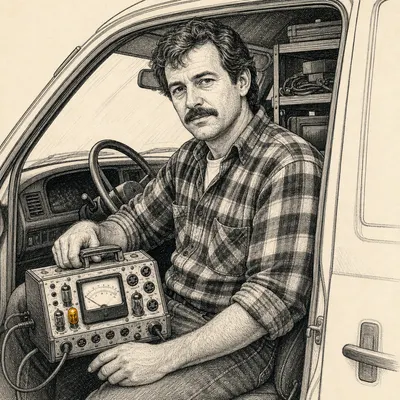
Ohmsville is a town that does not exist. The electronics kit in it is real: a board with rows of little springs screwed to it, a drawer of parts, and a manual of projects you build by pushing wires between the springs — no soldering, and nothing you cannot pull back out. Seven made-up people tell the stories on this site, and over the next seven weeks I am going to sit down with each of them and ask roughly the same six questions. I am Nate Pruitt. I write the posts here, I was born in this town in 1974, and I moved back last year with my nine-year-old, Milo.
We start with Ray Kessler, because he is the oldest voice we have. Ray was nine in 1974 and came out of the electronics shop on the strip with a box he was not big enough to carry: the hundred-and-fifty-project kit, the one with the wooden frame. He never left town. He fixed televisions here for thirty-one years, and from the day the first ones arrived, the video tape machines too. We talked in his garage, which is where his own kit still sits.
Nate: Give me the start of it. Where does a person get a box like that at nine years old?
Ray: Off a shelf, at the shop in the middle of the strip, and my mother paid for it thinking it was a radio. It was the wooden-framed one. A hundred and fifty projects, and a manual thicker than anything school ever asked me to read. I got it home and the first thing that actually went was a lamp — a small bulb, a battery, a button. I was in everybody's living room later on, but that was the first room, and it was mine.
Nate: The manual you keep under the counter — you do not have a counter, but you know the one I mean. Which booklet is it?
Ray: Logic Lane. That is the fifth booklet, the last one, and it is the one I would have wanted at nine and could not have used. It has the chip that keeps time in it, the gates that decide things, and the little grid of lights that the board paints one line at a time, far too fast for you to see it happening. That last one is a television. That is genuinely all a picture is — one dot at a time, in rows, going quick enough that your eye gives up and calls it a face. I spent thirty-one years opening the backs of sets and I did not have that laid out on two pages until this thing existed.
Nate: Which mission, then? For anybody reading who has not met one: a mission is a run of four or five circuits with a story over the top, and an ending.
Ray: The Arcade. Same reason. It builds a die out of a clock, then a race for two people, and then it builds a screen, and the screen is the bit. It scans. There is a counter walking along the rows and a chip clocking it, and if you slow that clock down the picture comes apart in front of you into the dots it was always made of. I used to explain that to people in their living rooms with the back off a set and a screwdriver in my hand, and about one in ten wanted to know. Here you can just do it.
Nate: And the build you would hand a stranger? Something for somebody who has never had the lid off anything.
Ray: Light the lamp. A battery, a button and a bulb, and that is the whole loop. The reason I hand people that one is what the numbers do. The filament — the thread of tungsten wire inside the glass — is a resistor, which means it holds the current back, and cold it barely holds it back at all. So the instant you close the loop it gulps: around five hundred and sixty milliamps. Then the wire heats up in about a twentieth of a second, holds back harder, and settles at sixty-three. A bulb is a part that changes while you watch it. I found that out because I was looking, and I had nobody to tell.
Nate: What broke your trade?
Ray: Screws, or the end of them. A set came in one day with no screws in it at all, and for a man whose whole job was getting inside things, a sealed case is the end of the conversation. Inside four years the phone had stopped ringing. I stayed anyway, and I am not sour about it.
Nate: Last one. Why talk to me at all?
Ray: Because nobody has asked in a long time, and I am pleased to be asked.
Ray is a character. The stories are ours. His own page, with the rest of what he narrates, is at Ray Kessler, and the street he is at the end of — one strip of shops, walked in four decades — is the town of Ohmsville.
Next week: Sal Marchetti, who answered a card in a shop window and never came back out from behind the counter.