Meet Sal Marchetti, who has been behind the same counter since the shop opened
Part 2 of 7 · Meet the Townsfolk
Part two of seven. Sal answered a card in the window, arrived knowing none of it, and taught himself out of the first booklet — which is still under the counter, and which he will still hand you before he hands you an opinion.
Second of seven. If you have just landed here: Ohmsville is a made-up town, the electronics kit in it is real — a board of springs, a drawer of parts, a manual of projects — and I am spending seven weeks asking the seven people who narrate this site the same handful of questions. I am Nate Pruitt; I write the posts, and I moved back here last year.
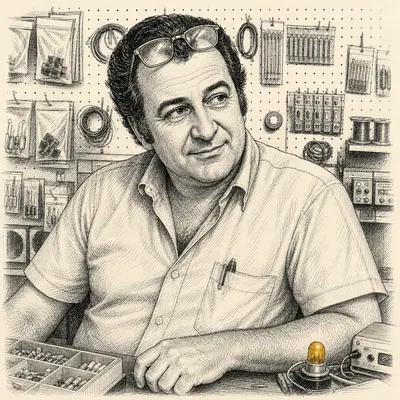
The shop in the middle of the strip is called The Electric Connection, and the man behind the counter is Sal Marchetti. He has stood there since the week it opened, which means he sold Ray the hundred-and-fifty-project kit in 1974 and, ten years later, sold half the town the two-hundred-project one. He is the voice you hear on the lessons. In the storytelling frame we use here he is the guide and never the hero — the hero is whoever is holding the wire.
Nate: You did not arrive an expert. Tell me what the first week was actually like.
Sal: There was a card in the window the week this place opened and I answered it. Then I was standing in front of a wall of little drawers with no idea which one did what, and customers coming in expecting me to know. So I took a kit off my own shelf and worked the manual front to back, in the evenings, out of self-defence. Everything after that I learned off the people who came in. They ask the same question twice and I do not mind — the second asking is the useful one, because it tells me which part of it I explained badly the first time.
Nate: So the manual you keep under the counter is a literal one.
Sal: It is that one. First Light, the first booklet — batteries, resistors, the two little lights, and the loop that joins them all up. It has my thumbprints on it. There is nothing in it that needs a part out of the drawer; everything is already screwed to the board, which is why it is the one I put in front of somebody who has never done this. A resistor, for anybody who has not met one: a small part whose whole job is to hold current back by a fixed amount, so the rest of the circuit gets a sensible share of it. Four fat stripes on the side tell you how much. That booklet is where the stripes start meaning something.
Nate: A mission, then. The missions are the story runs — four or five circuits with a plot and an ending on them.
Sal: Flashlight Discovery, and I will tell you why a shopkeeper picks that one. A flashlight is the first electrical thing most people ever own, and there are five different circuits hiding in one tube — the plain loop, the switch, what the bulb does when it is cold, the way two cells stack up. Somebody comes in who does not know where to start, and I do not want to start them on a chip. I want to start them on a thing they have already held.
Nate: And the build you would hand a stranger?
Sal: The smoke test, and I know how that sounds. Nine volts straight across a hundred-ohm resistor, nothing else in the loop. Nine volts across a hundred ohms is ninety milliamps, and nine times nought-point-nine-oh is a little over eight tenths of a watt. That part is a quarter-watt part. The number printed on a component is a promise about heat — how much of it the thing can get rid of before it cooks — and we have just broken that promise by more than three times. So it burns, in a blink, and the board resets and hands you another one. I would rather a person met that on a screen with me standing here than met it in their kitchen with the good kit. Everything after that, they believe me about the fat blocks.
Nate: What changed in here over the years?
Sal: The shelves turned. Phone cords where the resistors used to be, and one short aisle for everything I came here for. I stayed. Somebody here has to be the one who hands you a part and a number instead of a shrug.
Nate: What do you want out of somebody who comes in the door?
Sal: That they ask twice. Nobody gets it the first time, and the ones who pretend they did never come back.
Sal is a character. The stories are ours. His page is Sal Marchetti, the lessons in his voice are in the classroom, and the strip his shop is halfway along is the town of Ohmsville.
Next week: Emmett Crane, who ran the projector at the Bijou on weeknights and wore a cape on Fridays.