Meet Vera Holcomb, who pushed four desks together and got a club out of it
Part 4 of 7 · Meet the Townsfolk
Part four of seven. Two pupils stayed behind in 1978 to ask why the lamp got hot enough to burn a finger. She had no budget and no period to answer in, so she bought a kit with her own money and made a room.
Fourth of seven. The town is invented and the kit is real: a board with springs on it, a drawer of parts, and a manual you work through. I am Nate Pruitt, I write the posts here, and I am asking the seven people who narrate this site the same six questions, one a week.
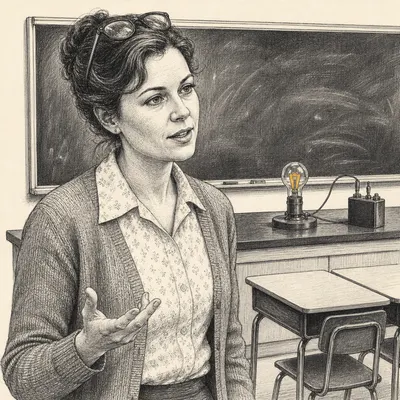
Vera Holcomb taught eighth-grade science at Ohmsville Junior High for twenty-six years. The Builders' Club — the after-school thing half the town went through — is hers, and it started in the autumn of 1978 with two thirteen-year-olds who would not leave. She is the voice on anything set in a classroom after the bell. We talked in the science room, at the four desks, which are still pushed together.
Nate: Start me with the two who stayed behind.
Vera: I had done a demonstration with a small bulb and a battery, and one of them put a finger on the glass and got a shock of a different kind — it was hot. Properly hot, out of a thing running off one little battery. So the two of them stayed after the bell and asked me why, and I did not have an answer I could give in the four minutes before the next class walked in. I had no budget for one either. So I pushed four desks together on a Thursday, went down to the shop on the strip, bought a kit with my own money, and let the two of them work the manual front to back while I marked papers at the front of the room. I was about two weeks ahead of them at best. By Christmas there were nine of them and a name on the door.
Nate: The manual you keep under the counter — yours would be in a desk drawer.
Vera: Sound & Sense, the third booklet, because the answer to that Thursday question is in it. It is the booklet where the kit starts to notice the room — a cell that reads sunlight, plates that read a finger, a bead that reads heat — and it is also the one with the small bulb, the one you can push until it gives up. That is the page I would have wanted on the Thursday, and it is the page I still open when somebody asks me why anything gets warm.
Nate: A mission?
Vera: Robot Car Discovery. Two eyes, two wheels, and no code anywhere — the car steers itself by nothing more than one light sensor per side wired to one motor per side, so the side that sees less drives less and the whole thing turns towards the light without anybody telling it to. I can put two pupils in front of that and get on with my marking, and they will arrive at the idea themselves, and having arrived at it they will not forget it. That is worth more than me saying it at a board.
Nate: The build you would hand a stranger.
Vera: Burn out a lamp, which I accept is an odd thing for a teacher to choose. Two batteries stacked in a row instead of one: eighteen volts through a filament built for nine. Twice the volts through the same thread of wire is twice the current and four times the heat, and the heat has nowhere to go — it is a glass bead the size of a pea. Sixty-odd milliamps, about half a watt, in that. It gets brighter than it has any business being, and then it opens and it is finished. Nobody who has watched it asks me again why a part has a number printed on it. That whole answer took my first Thursday, and it is still the best afternoon I ever spent in this room.
Nate: Twenty-six years. What did you keep?
Vera: Every sign-in sheet, every year I ran the club. I can still tell you which project each of them got stuck on. I did not find this place and I was not born into it. I made a room in it, after school, for the kids who had.
Vera is a character. The stories are ours. Her page is Vera Holcomb, and the junior high she taught in is at the far end of the town of Ohmsville.
Next week is my own turn, which is going to be strange, and then the two who mind the front of the shop on a Saturday.