The computer on the counter
Part 3 of 3 · Ray's Notebook
Page three of Ray Kessler's service notebook, and the only one with nothing to repair in it. A sealed beige machine at the big-box store in 1984, a boy who pressed one key, and a mark that stayed on the screen after he let go.
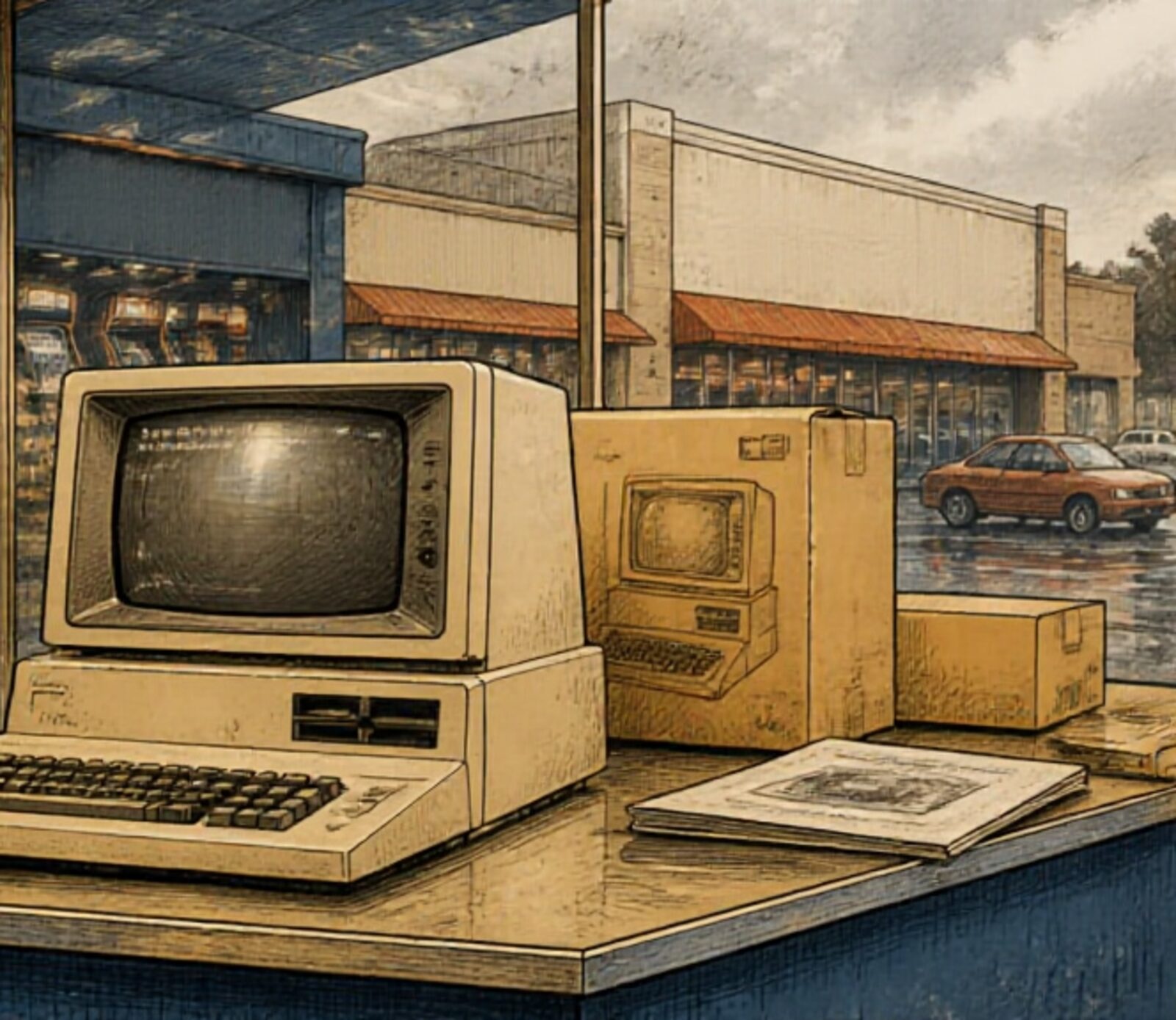
Ray Kessler lives four doors up from me. He fixed televisions in this town for thirty-one years, and the notebook on my kitchen table is the log he kept at the bench — a page for every time a device did something it was not built to do. One a week, and he checks that I have not tidied his sentences. This page is the odd one out, because nothing on it is broken and Ray does not repair anything. I wanted it up early anyway. I write software for a living, which means I use electronics all day and have never once been shown the inside of any of it, and this is the afternoon in 1984 when that arrangement arrived in Ohmsville and sat on a counter.
The page: Ohmsville, 1984
The town was at its peak that year, which meant there was always something new making a sound. A compressor kicked on behind the pharmacy. A delivery truck sighed at the kerb. From the arcade came the bright electronic chatter of machines winning and losing without patience. I had been fixing televisions at the back of Sal's shop for four years, long enough to know that a place announces itself through its repairs. A loose connection makes one kind of silence. A tired tube makes another.
That afternoon I walked past the pizza place and turned in at the big-box store, which took up more room than the rest of the strip and seemed to know it. Wider aisles, higher ceilings, and nobody behind the counter who knew a customer's name.
Near the front, under the fluorescent lights, a computer sat on the counter between paper receipts and stacked cardboard. There was no badge on it anywhere that I could see. It was a beige plastic case about the size of a bread box, with the keyboard built into the front of it and a small screen standing up at the back, dark and watchful. The keys made a neat field of pale squares. A cable ran off behind the machine to a cassette recorder tucked against the wall, which was how you kept whatever you had typed. The whole arrangement had the faint warmth of electronics that have been switched on long enough to be quietly alive.
A boy of about twelve stood at the counter with his hands behind his back. He had the careful posture of somebody near a sleeping animal. He leaned in and pulled away again without touching it. Carts rolled over the seams in the floor behind us, and a clerk tore a receipt off a machine without looking up.
I understood the hesitation. On our strip most things invited you to see how they worked. A radio could be turned over and its screws counted. A plywood speaker cabinet showed you its corners. A kit came in parts, and the parts carried their own explanations: wire to terminal, terminal to switch, switch to lamp. This machine offered the opposite lesson. It had a case, a keyboard, a cable and a dark face, and the useful things were inside, behind plastic that looked finished.
The boy lifted one finger and pressed a key. The sound was smaller than anything in the arcade, a dry plastic tap under the fluorescent hum. On the screen a single block of light appeared and waited. He pressed another key and the mark changed. Nothing else happened, but his shoulders came down. He had not broken it. He had made it answer.
Then he took his hand off the keyboard, and the mark stayed where it was.
That is the part I wrote down. Nothing was holding it there that either of us could point at. No finger, no switch, nothing moving. He noticed the cable next, not because it moved but because it did not, running from the back of the case in a careful loop to the recorder. He crouched to see the side of the machine and found a seam under the keyboard, the suggestion of screws, and a narrow dark port with a purpose he could not name. The thing was closed, but it was not entirely without clues.
People began to gather without admitting they were gathering. A woman waiting on a receipt stopped with her hand on her cart. A man carrying a box looked over the top of it. The clerk glanced at the counter and then back down the aisle. It was not like the crowd around a cabinet in the arcade, where everybody watches the hands and the score. Here they were watching the object. The computer made a small quiet room inside the larger store, built out of pauses.
The sealed case explains why I could not look inside, and I have no complaint about that; a shop is not obliged to let a repairman take its stock apart. What the sealed case does not explain is why eight or nine adults stopped what they were doing to watch a boy press one key. I have thought about that a good deal more than I have thought about the machine.
I walked back along the familiar route. The arcade and a transistor radio overlapped in the warm afternoon air, one bright and electronic, the other carrying a little static between songs. The pharmacy bell rang behind me. Ohmsville had not become a different town. It had put a new kind of question in a window.
What Ray found
Nothing was broken, so there was nothing to find. What could be verified from outside the case was the one thing the boy noticed: the mark stayed on the screen after he let go of the key. Something in there was holding a number until it was told a different one, with nothing moving and no finger on it. That is storage, and it is the whole difference between the machines on the strip and the machine on that counter.
You can hold a number with parts you are allowed to look at. Wire the counter to the display and tap the button: the digit goes up by one every time the clock pin goes from low to high, 0 through 9, then round to 0 again. Take your finger off and the digit stays. The four wires between the counter and the display carry that number in binary, and you can watch each of them go high and low — which is exactly the part the beige case would not let anybody see.