The cabinet at opening time
Part 2 of 3 · Ray's Notebook
Page two of Ray Kessler's service notebook. A driving cabinet that would not wake on a Saturday morning in 1984, a blown fuse that was not the fault, and a picture that came back crooked and stayed that way.
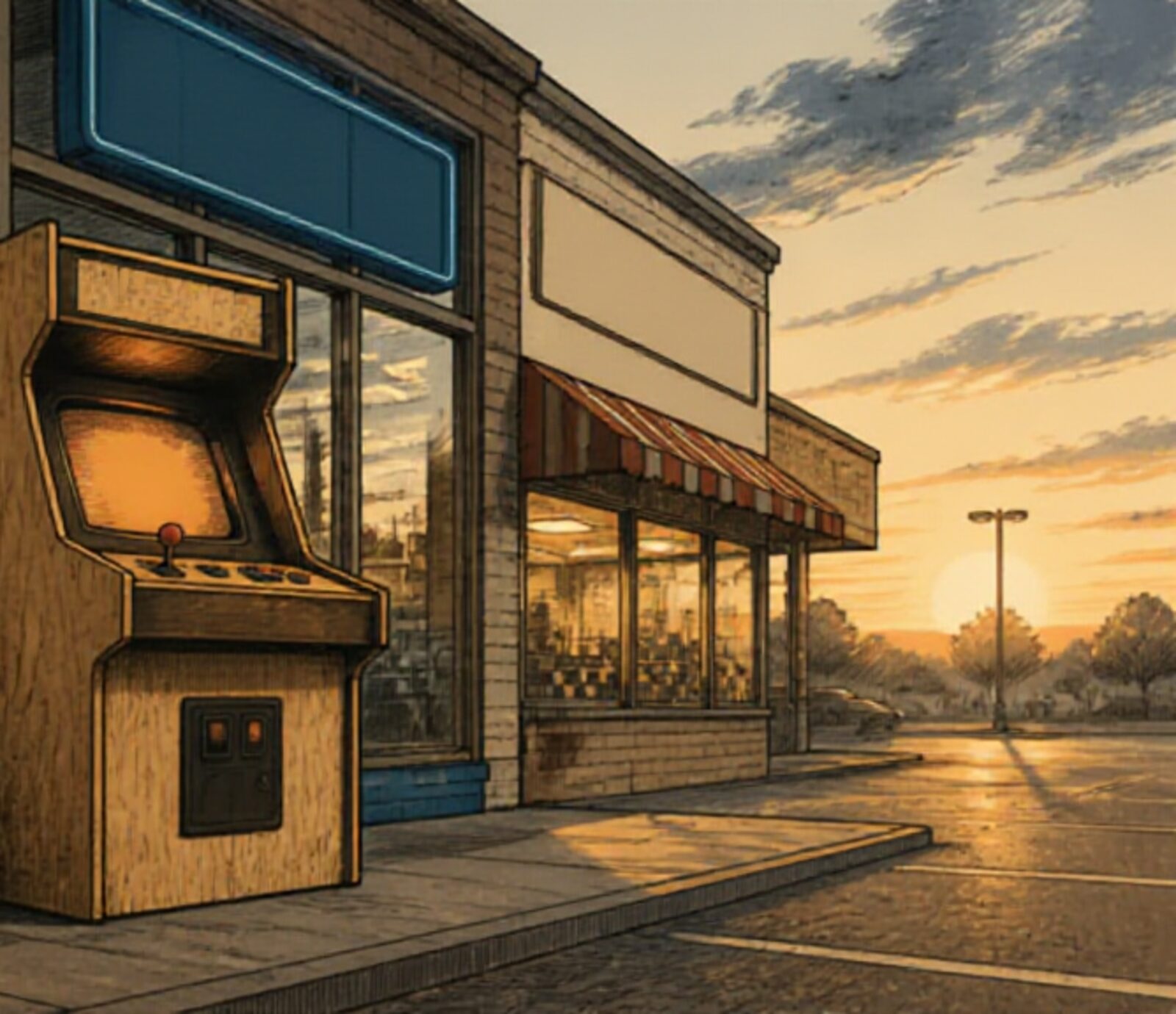
Ray Kessler lives four doors up from me. He fixed televisions in this town for thirty-one years, and the notebook on my kitchen table is the service log he kept while he did it: a page for every time a device did something it was not built to do. He is letting me put one up a week. I picked this one because of something I got wrong on the first read: I have Ray down as an old man in every story he tells, and on this page he is nineteen, four years into the bench in the back room of Sal Marchetti's shop, standing in an arcade doorway watching somebody else do the work.
The page: Ohmsville, 1984
Saturday morning arrived on the strip as a set of small electrical noises. The pharmacy bell gave one polite ring behind its glass before the first car had settled into a space. Sal had the shop door propped with a wooden block, letting out the dry smell of cardboard and solder and warm dust, and behind me at the back bench a test tone was rising and falling, patient as somebody on hold. At the end of the walkway, beside the pizza place, the arcade was lifting its shutter one reluctant foot at a time.
The cabinet was at the far end of the room and I had not seen it whole before. A driving game, or a chase game. Heavy plywood, a sloping top, a control panel scratched down to the lighter wood underneath, the edges faced in kraft cardboard where a printed panel would have gone. Two real switches sat beside the wheel, one red and one black, both too big for the neat plastic world they were meant to command. The screen showed a pale horizontal line and nothing else.
Hal Denning, who owns the arcade, tried the power first. He pressed the plug in, checked it, pulled it half out and pressed it in again. The line did not move. A teenager waiting by the door came closer with a kit in a paper bag, and the bag made the soft crowded rattle of screws and wire and something with a metal case.
Hal opened the back. Inside, the wires travelled without much ceremony: bundled where a hand had thought to bundle them, taped where a hand had run out of patience, otherwise taking the shortest route between one useful thing and the next. He tightened a loose wire near the power connection. He brushed dust off the vents with a folded receipt. Both of those are ordinary moves, and that is the important part. Machines almost never start with a mystery. They start with a connection somebody stopped seeing.
Then he pulled the fuse, turned it to the light, and there was the break inside the glass. A fresh one came out of the drawer under the counter. The cabinet seemed to gather itself, the speakers gave a dry pop, and the pale line shivered once and went back where it had been.
I knew that sound from sets carried into the back of Sal's shop in laundry baskets. A fuse can be the whole story, or the part of it that has become visible. I had been taking the backs off televisions for four years by then, long enough to have been fooled by a fuse twice.
Hal asked the teenager to hold the flashlight lower. The beam found a narrow terminal strip behind the screen, and one wire had been pushed under a screw head instead of clamped beneath it. It was making contact in the manner of a person leaning against a door rather than closing it. He loosened the screw, cleaned the terminal with the edge of a small file, and the teenager handed over a short length of wire — not new, just clean enough to be useful. Hal stripped the ends and the copper came up bright as a thin sunrise. The wire went under the screw. The screw went down. He checked it twice, the second time for confidence rather than information, and he put the back panel on without tightening every fastener, because a cabinet will need opening again sooner or later.
When he switched it on, the pale line widened into a grey field. A crooked block of colour appeared in one corner, blue or green depending on how the light hit it. The speaker made three notes, missed the fourth, and went back to the first. A small shape crossed the screen sideways and vanished. It was not a car exactly. It was the suggestion of one, assembled out of rectangles and timing.
The children outside made a sound that went through the room before anybody had touched the controls. One of them put both hands flat on the scratched panel, a finger on each switch, and did nothing at all for a second, because wonder has its own hesitation. Then the switch clicked. The machine gave a thin whine, the shape came back with a burst of static behind it, and the picture rolled halfway up the screen and stopped there at an angle. Hal reached for the back panel. The teenager shook their head. We watched. The picture held.
The fuse explains the silence. The wire under the screw explains the fuse. Neither of them explains a picture that climbs half a screen, stops crooked, and then runs like that all morning without getting any worse, and I am not going to pretend otherwise. A machine that works badly all day is a different animal from a machine that has been fixed.
What Ray found
The fuse had opened, and the fuse was the symptom. Behind the screen a wire had been pushed under a screw head instead of clamped beneath it, so it was touching by pressure alone. A joint like that has resistance where there is supposed to be none: it warms, the current through it is unsteady, and something upstream eventually takes the load. Cleaning the terminal and putting a fresh wire properly under the screw is what fixed it.
A fuse is a promise about heat, and so is the number printed on a resistor. Put 100 Ω straight across 9 V on the bench and watch what happens: 9 V across 100 Ω is 90 mA, and 9 × 0.09 is 0.81 W going into a part rated for a quarter of one. It lasts about as long as that fuse did. Reset the kit and the resistor comes back, which is the one thing the bench gets to do that the arcade did not.