The portraits on the wall
Part 1 of 3 · Ray's Notebook
Page one of Ray Kessler's service notebook. A shop in 1978, a kit on a plywood stand, and a lamp that went out while a thirteen-year-old watched somebody find out why.
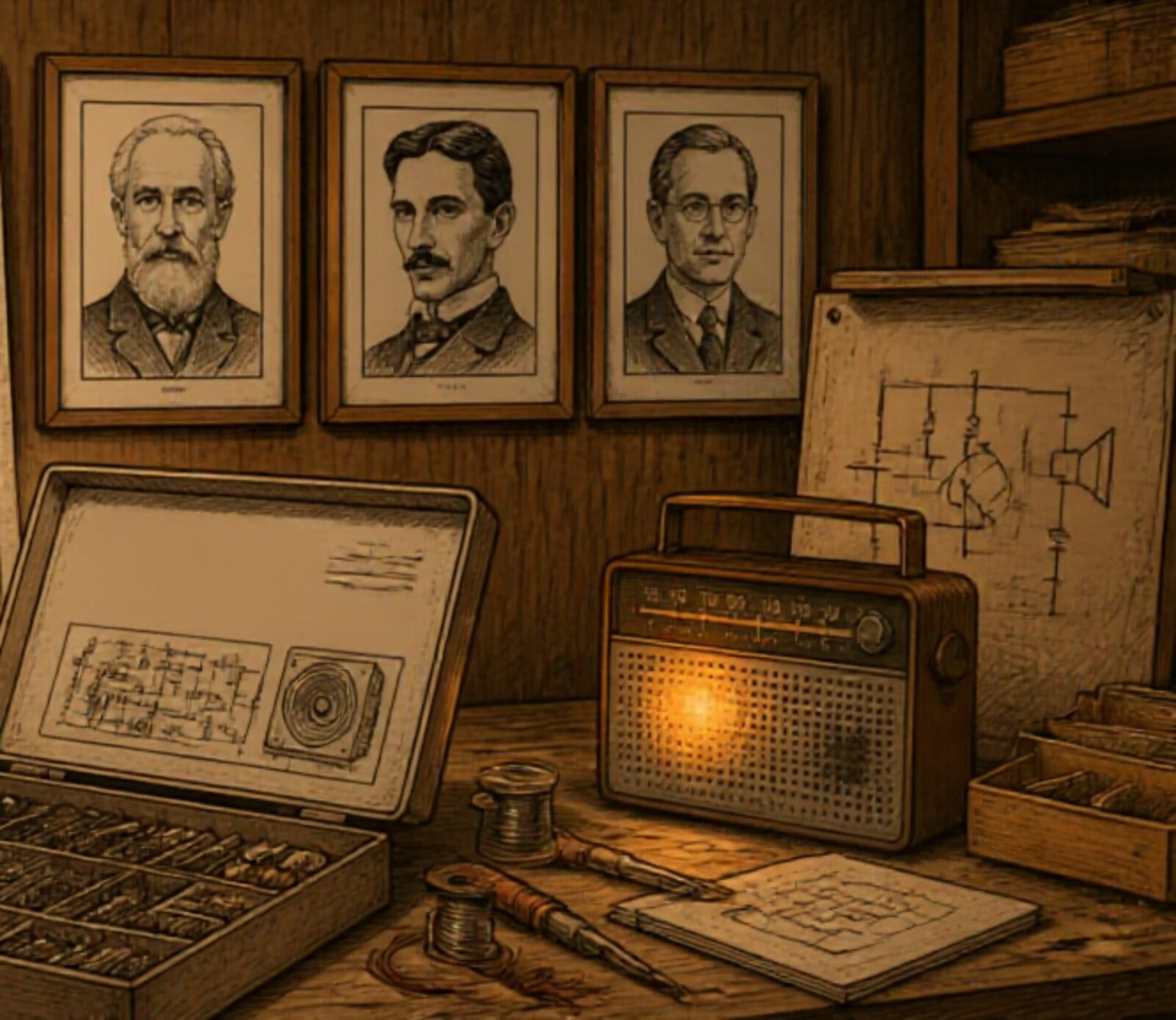
I am Nate Pruitt, and Ray Kessler lives four doors up from us. He fixed televisions in this town for thirty-one years. Two weeks ago my son asked him how a thing can work on Tuesday and be dead on Wednesday when nobody touched it, and instead of answering, Ray came back with a notebook — the service log from his bench, the page he wrote whenever a device did something it was not built to do. He has let me put one up a week, as long as I type them properly and leave his sentences alone. This is the oldest page in it: Ray is thirteen, on the customer side of Sal Marchetti's counter.
The page: Ohmsville, 1978
I am putting this one first although I wrote it last, because it is where I learned the only thing I actually know.
The electronics shop on the strip was a room that had been assembled rather than finished. Wood panelling, darker in the places where hands went. Warm orange light under the shelves that made everything on them look older than it was. A transistor radio murmured near the register, and its signal thinned and came back whenever anybody walked past it. There was no arcade at the end of the strip yet; the bright thing that year was in our own window, a video board somebody in town had built out of a box and two controls, two pale paddles crossing a dark screen.
I was thirteen. I had had my own kit for four years and had never once wondered where the metal met.
Sal brought the shop's demonstration kit out from under the counter and set it on a plywood stand. He handled it the way you handle a tool that gets used often. It was the 150-in-1, its board held in a wooden frame, the face of it crowded with spring terminals and the small real parts the catalogue pictures had made look weightless. Resistors with coloured bands. A lamp. Coils wound in fine wire. A switch that clicked without much confidence. The grain ran under the printed numbers and disappeared at the corners, and somebody had circled several terminals in pencil.
Sal unfolded the instruction sheet and picked a circuit: a battery, a switch, a lamp. Three parts and two wires. He moved slowly, because hurrying makes a simple thing look mysterious. He set a wire between two springs, checked the battery clip, and turned the switch.
For a moment nothing happened. Then the lamp gave a weak yellow flicker, and the radio by the register answered with a brief wash of static, as if the two of them had noticed each other across the counter. Sal moved one connection and tried again. The lamp brightened and held, and I leaned in close enough to see the filament.
Then the lamp went out, and the radio lost its murmur in the same second.
Sal held the switch down and let it up. He touched the battery clip. He looked at the board with the patient irritation of a man meeting an old acquaintance. Then he pressed one spring with the tip of a pencil, and the lamp blinked once.
That blink is the whole page. The trouble was not inside the idea of the circuit. It was at the place where one piece of metal was supposed to meet another.
He lifted the wire out. Under it the spring was worn bright from years of being opened and let go, and beside the terminal somebody had written CHECK THIS in pencil with the second word underlined twice. There were older repairs near it that nobody had erased, because erasing them would have erased the history of finding them. Sal bent the wire end into a fresh curve, wiped it on his sleeve, and pushed it back under the spring where the metal was still clean. The lamp stayed on after that — a modest light, bright enough to make the colour bands readable.
While he worked I looked past the board at the portraits on the wall. Volta had the expression of a man who learned to measure a force before he would name it, and Galvani looked rather more surrounded by questions. Between them hung a faded card about the old argument over a frog's leg. I knew that story the way you know anything passed from one book to the next, and I did not give either man a voice; those were photographs of drawings, not doors into a head. But a leg twitching on a table and a lamp going dark because a spring had lost its grip are the same kind of event, and the answer to both was in how the thing had been put together.
The spring explains the lamp. It explains the radio too, once you know that a contact opening under current makes a spark, and that a spark is a small transmitter spraying noise across the whole band — which is why an AM set buzzes when somebody upstairs hits a light switch. Both halves had an answer and I wrote both down that night. What the spring does not explain is why a bad joint on an ordinary afternoon decided what I would do with the next four decades. A fault tells you what happened. It has never once told me what it meant.
Sal folded the paper catalogue and set it aside for me. I carried it home under my coat, and the streetlights made the pavement look like another kind of board, marked with lines that went somewhere if you followed them carefully.
What Ray found
A spring terminal that had lost its pressure. It had been bent back and let go a few thousand times, the copper end sitting in it had gone dull with oxide, and the two were touching without gripping — a joint that conducts when you press it and not when you leave it alone. Bending the wire into a fresh curve and reseating it on clean metal is the repair.
A lamp is the best place on the bench to see why a joint like that fails exactly when nobody is watching. Light the lamp and hold the button. Cold tungsten is about 15 Ω, so the instant the loop closes the lamp pulls close to 560 mA; hot, at about 143 Ω, it settles near 63 mA. A tired spring will carry the 63 and drop the 560, which is why a lamp dies on the press and looks perfectly healthy to a meter a second later.